Play classic games
Play DOS games on FreeDOS! We include lots of fun games in the distribution. Or play your favorite classic games, like Wolfenstein 3D, Doom, Commander Keen, Jill of the Jungle, Duke Nukem, and many others!
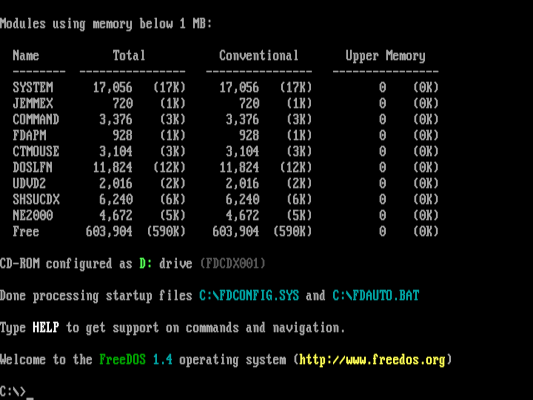
FreeDOS is an open source DOS-compatible operating system that you can use to play classic DOS games, run legacy business software, or write new DOS programs. Any program that works on MS-DOS should also run on FreeDOS.
Play DOS games on FreeDOS! We include lots of fun games in the distribution. Or play your favorite classic games, like Wolfenstein 3D, Doom, Commander Keen, Jill of the Jungle, Duke Nukem, and many others!
Run your favorite DOS programs with FreeDOS. Just install your DOS application under FreeDOS like you would any other DOS application and you'll be good to go.
We include lots of open source compilers, assemblers, debuggers, and editors so you can create your own DOS programs. We also share our source code under an open source license, so you can modify FreeDOS itself.
Javier Gutiérrez Chamorro has made a huge update to his Zerofill tool, which fills empty space on a drive with zeroes (helps with virtual machine disk compression). Version 4.10 has huge improvements, including: Rewritten to avoid int64/long long so binary is smaller, Use bigger blocks and bigger file to make process twice as fast, Rewritten as TUI with WCONIO. Download and source code are available from Zerofill on Sourceforge
mTCP is a set of TCP/IP programs for your PC compatible computers running DOS. Mike Brutman recently announced that a new mTCP is available! This version has some bug fixes, adds black and white Sixel graphics to Telnet, makes Ping more accurate, and has major performance improvements for NetDrive. The HTTP server source code is also now included. Download the new from from the mTCP website
Please help us test the next version of FreeDOS! Thanks to Jerome, our distribution manager, we are able to share a new "test" distribution every month. These monthly releases collect all new changes, and act as a "test bed" to become the next official FreeDOS distribution, and we would like your help to test it. The new "T2610" ("T" for test, "26" for 2026, "10" for October) distribution includes updates to VSBHDA, SBEMU, Himem, TinyAsm, Blocek, Lynx, FDNPKG16, plus several new translations. Since August, we've also included an updated kernel and other tools. Download the test release and let us know if you have any problems.
Victoria Crenshaw has been working on FDNPKG16, the package manager that works on 16-bit computers. Victoria writes: "Fixed an insane amount of bugs. (10+) The version control log has all the changes. FDNPKG16 is very stable now." There may be another update coming soon, but needs your help testing this one first. Find it at FDNPKG16 on GitHub or more directly at ver. 0.99.8254f release
We announced the previous 0.99.8254e version a few days ago: "Newest version released is a massive bug fix with the networking a bit" and adds "It just needs 640k of RAM with 480k of free RAM." You can find it at FDNPKG16 on GitHub or more directly at the ver. 0.99.8254e release
Blocek is text editor for DOS with unicode support. It means that unlike other DOS editors you are not limited to your current code page. Laaca recently updated Blocek to version 1.77b, now translated to 26 languages, plus a few bug fixes. Laaca writes: "I also found two or three minor bugs in program and it is corrected now. And I added specific font files for Belarus language and new TBL filters for Ukrainan, Belarus and Maltese/Esperanto." Get the new release from the Blocek website. We've also mirrored this release in the FreeDOS Files Archive at Ibiblio, under /edit/blocek/1.77b.
A few weeks ago, Laaca released version 1.77. Here's the feature list from that version: The default Unicode font UNISMALL.FU was renamed to UNIVGA.FU and was updated to support euro and ruble currency symbols + file selector can now sort files also by time and extension + new button "step up" in the file selector + support for monospaced mode + it is now possible to define Alt key assignments in keyboard layouts. Laaca also notes "I have to thank to Fritz Mueller for his help and for translations to new languages."
Laaca's MySysInf is a system-information tool, useful if you want to learn more about your system: "MySysInf is a DOS port of utility NeoFetch known from Linux and other UNIXes." Laaca recently released version 1.21, which fixes a problem when running under Windows 10. Get the updated version at mysysinf.zip (www.laaca.borec.cz) {note: that's a zip file} from Laaca's website.